25 ene 2017

History of geometry

When teaching Geometry in Middle or High School we shouldn't focuse only on figures, shapes, sizes, areas and volumes; we may also go beyond that. What about teaching something about history?

Let's start talking about Euclid, the Father of Geoemtry.

You can visit the following pages to learn something about him and other facts of the history of Geometry:

A brief information about the very beginning of geoemtry.

Do you know who was Euclid?

Or, if you prefer you just may read the following text:

Euclid, the Father of Geometry


Greek Mathematics
Euclid enters history as one of the greatest of all mathematicians and he is often referred to as the father of geometry. The standard geometry most of us learned in school is called Euclidian Geometry.
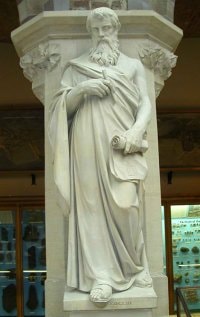
Euclid Statue
Statue of Euclid in Oxford (Public Domain)
Euclid gathered up all of the knowledge developed in Greek mathematics at that time and created his great work, a book called 'The Elements' (c300 BCE). This treatise is unequaled in the history of science and could safely lay claim to being the most influential non-religious book of all time.
Euclid probably attended Plato's academy in Athens before moving to Alexandria, in Egypt. At this time, the city had a huge library and the ready availability of papyrus made it the center for books, the major reasons why great minds such as Heron of Alexandria and Euclid based themselves there.

Euclid's Elements

Elements Title Page
Euclid's Elements Title Page (Public Domain)
Euclid's great work consisted of thirteen books covering a vast body of mathematical knowledge, spanning arithmetic, geometry and number theory. The books are organized by subjects, covering every area of mathematics developed by the Greeks:
  • Books I - IV, and Book VI: Plane Geometry
  • Books XI - XIII: Solid Geometry
  • Books V and X: Magnitudes and Ratios
  • Books VII - IX: Whole Numbers

The basic structure of the elements begins with Euclid establishing axioms, the starting point from which he developed 465 propositions, progressing from his first established principles to the unknown in a series of steps, a process that he called the 'Synthetic Approach.' He looked at mathematics as a whole, but was concentrated on geometry and that particular discipline formed the basis of his work.

Euclid's Axioms [go to https://explorable.com/euclid] 

Euclid's Influence

The reason that Euclid was so influential is that his work is more than just an explanation of geometry or even of mathematics. The way in which he used logic and demanded proof for every theorem shaped the ideas of western philosophers right up until the present day. Great philosopher mathematicians such as Descartes and Newton presented their philosophical works using Euclid's structure and format, moving from simple first principles to complicated concepts. Abraham Lincoln was a fan, and the US Declaration of Independence used Euclid's axiomatic system.
Apart from the Elements, Euclid also wrote works about astronomy, mirrors, optics, perspective and music theory, although many of his works are lost to posterity. Certainly, he can go down in history as one of the greatest mathematicians of all time, and he was certainly one of the giants upon whose shoulders Newton stood.

31 ene 2014

Taller de álgebra (en Inglés)


Today I was thinking about my eight grade students and I came up with this workshop that I want to share with you... 

Algebra Reviewing
Workshop

Key concepts

Polynomial, Monomial, Binomial, Trinomial, Exponent, Coefficient, Constant, Degree of a polynomial, leading coefficient, like terms, Variable, Algebra, quotient, product.

Fill in the blanks with the correct concept...

1) A ________________________ is an algebraic expression that contains sums of variables with coefficients and exponents.

2) A ___________________ is a number that goes before a variable in an algebraic expression (like any polynomial).

3) The ________________________ of a polynomial is given by the term with the greatest exponent.

4) In an algebraic expression, the ___________________ are terms that contain the same variables raised to the same power. Only the numerical coefficients are different.

5) A __________________ is a polynomial that contains only one term (it can be a number or a variable with coefficient and exponent)

6) A _________________ is a polynomial that contains two terms.

7) An ________________ refers to the number of times a number is multiplied by itself.

8) A __________________ is a term in an algebraic expression that contains only numbers (without variables).

9) A _________________ in an algebraic expression is represented by letters. Those letters are actually numbers in disguise.

10) In a polynomial, the _________________________ is the coefficient of the term with the highest exponent (or highest degree).

 
Second Part: A letter puzzle

Find here some of the key concepts given.


             A  B  F  G  H  I  J  L  A  V  A  R  I  A  B  L  E  T  Y
         D  R  I  S  K A  E  T  L  M  O  P  E  Y  P  O  L  I  N  O  M
    T  O  P  R  E  A  S X  P  I  W  A  L  G  E  B  R  A  Y  R  E  S  T
U  I  E  D  X  P  R  U P  O  L Y  N  O  M  I  A  L W  E  R  T  U  V  Y
G P  O  U  I  R  E  T  O  N  E  J  A  I  L  P  R  O  D  U  C  T  U  Y  W
Y  E  A  T  E  R  A I  N  A  D  I  V  I  S  O  R  Y  U  R  E  W   B  E  P
F A L  C  A  O  C  O  E  F  F  I  C  I  E  N  T  O  T  P  O  R  S  I  P  E
X  E  R  T  I  A  S  E  N  O  T  Y  U  E  D  O  U  B  L  W  K    N  O  M
S  P  O  Y  U  S O  P  T  P  O  P  U  E  C  O  N  S  T  A  N  T  O  R  U
A  N  P  A  P  O  T I   L  A  E  M  L  I  K  E  T  E  R  M  S A  M  O  P  E
R  O  T  D  E  G  R  E  E  T  O  P  U  E  R  J  A  I  B  E  R  T  I  B  L  O 
E  R  Y  P O  M  O  N  T R  I  N  O  M  I  A  L  D  P  E  F  T  A  P  T  P 
R  Q  U  O  T  I  E  N  T  P  F  J  L  M  N  B  A  E  I  P  W  S  L  N  E  W
U  N  I  T  E  D  W  O  R  L  D  A  N D  P  E  A  C  E  W  E  R  T  V  A 
 

Sorprendido

Si la verdad me sorpende que, no obstante el tiempo que llevo sin escribir en este blog, aún así siga teniendo un buen número de visitas. Obviamente no es el blog más popular de la web, eso es seguro, pero todo parece indicar que las matemáticas es un tema de gran interés para mucha gente. ¿O habrá otros motivos?